Bendre & Science
Dattatreya Ramachandra Bendre Endowment Lecture, University of Mumbai, 2006
Dr. K. S. Sharma & Dr. Waman Bendre · from the Kannada original
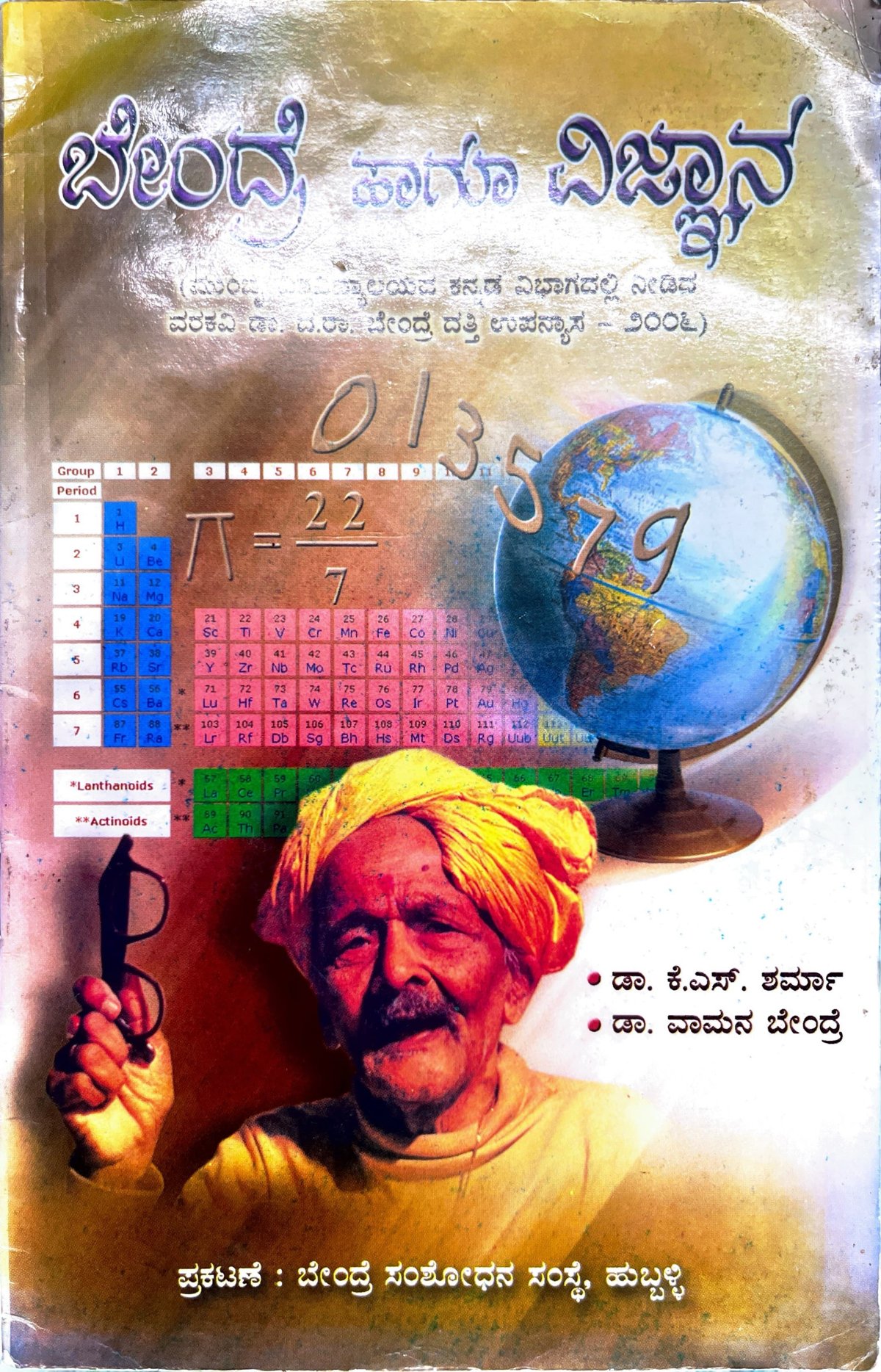
The fact that Dr Da Ra Bendre, a Jnanapith Award winner is recognised as a Mahakavi is common knowledge & well acknowledged worldover. However, what is not so well known is the fact that this very Dattatreya has another dimension to his personality - that of a Mahavijnani - a great science scholar. Not only was this Mahakavi a Mahavijnani; he was a Tattvajnani - a philosopher & a Mahamanava - a great human being. With his intense sadhana, in some sense, his yoga into literature & science, he emerged as an unique scholar - a Rasa-Rishi, a Bhava-Rishi.
There are many poets; very few really great ones. There are many scientists; very few brilliant ones. But a personality who exhibits three but a personality who exhibits three facets of brilliance; those of a Mahakavi - Mahavijnani - Mahatattvajnani; is truly one of a kind in this world - our own Dattatreya Ramachandra Bendre. I have undertaken the difficult task of delving into & sharing glimpses of the scientific facets of his personality to this august gathering of Bendre’s followers in Mumbai. ‘Bendre’s Science Doctrine & Experiments’ - this being the theme of my speech today; I would like to present the same through the three subjects of Numerology - Chemistry - Cosmology (Sankhyashastra - Rasayanashastra - Vishwashastra). Before I start my discourse, I would like to share with the audience an important fact. Dr Da Ra Bendre, in his personal library has a collection of over 16,000 books. They are catelogued into 102 diverse topics ranging from Veda-Puranas-Upanishads to modern scientific areas like Quantum physics & chemistry. In many of his books, Bendre has comments on subjects like numerology & other scientific matters noted in the form of poetry! The library has an unique collection of some of the finest books in Kannada, English, Hindi, Sanskrit & Marathi! The reason I bring this up is to let the audience imagine & understand the enormity of Bendre’s studies.
With this prelude, let us enter the curious world of Bendre’s science.
My namaskara to everyone. You may be wondering why I am paying my namaskaras to all now, instead of the beginning of my discourse, as is normal practice. I will begin my speech on Bendre’s Numerology through his commentary on the ‘Namaskara Mudra’.
“We all have two hands; ten fingers. When we join hands & do the Namaskara Mudra, there is a unique formation that happens. If we assign the numbers 1, 2, 3, 4, 5 to Kanisthika (little finger), Anamika (ring f), Madhyama (middle f), Tarjani (index f) & Angustha (thumb) - and similarly 6, 7, 8, 9, 10 to the fingers on the other hand from the thumb to the little finger - then, we make a Namaskara Mudra, and add the numbers assigned to the conjoined fingers, we get a Rudra number (number 11) each time. In each pair of numbers, you have a prime & a non-prime number - and the sum of each pair, Eleven is a prime number. When you join 5 to 5, not only does it form 10; but also 55. This Namaskara Mudra is a metaphoric representation of Kalki riding on a white steed, who pulls us into a new world - just like the prime number is elevated to a higher place through the Mudra. This is a never-before heard of knowedge - a Kalpi - a sage’s kalpi - a poet’s kalpi - a philosopher’s kalpi. This represents the right path to Dharma”
Bendre had studied Numerology very deeply. I would like to showcase the depth of his understanding & interpretations through these 3 topics. They are (1) Prime Numbers, (2) Perfect Numbers & (3) Pi
Just now, we had a brief glimpse of his studies into Prime Numbers when we talked about the Namaskara Mudra. Let us first look at the descriptions of Prime Numbers in Numerology & then come to Bendre’s interpretations on the same.
There are many theories in Numerology. Some of them are Fraction Theory, Theory of Surds, Theory of Negative Numbers, Theory of Pi, Prime Number Theory, Perfect Number Theory, Goldbach Conjecture Theory etc. Among all these theories, Bendre’s studies into Numerology mainly focused on the three theories - Prime Number, Perfect Number & Pi. What was the significance of focusing on these theories? When we go into the depth of understanding the reasons, we come to realise Bendre was no mere Numerologist, he was primarily a Philospher. He did not look at numbers merely as numbers; he considered them to be a means, a tool to carve out the personality of the human beings of the new age.
As per Grolier Encyclopedia, Greece’s Pythogarus & his followers, Alexandria’s Diophantus, India’s Brahmagupta & Aryabhata – all studied Prime Numbers. Euclid, way back in 200 BC in his work ‘’Elements’’ has mentioned the following special feature about Prime Numbers: ‘’A Prime Number being one whose only positive divisors are itself and 1. Any whole number greater than 1 is either a Prime Number or a product of Primes. The Prime factors of a number are unique and this constitutes the Fundamental Theorem of Arithmetic”.
Bendre, in his studies has not only defined Prime Numbers as indivisible & Non-Prime Numbers as divisible – but also called them as “Godly (Daiva)” and “Ungodly (Rakshasa)” Numbers respectively. Several years before the invention of computers, Bendre was able to identify thousands of Daiva Numbers. In this context, I would like to share an incident here. About 25 years back, when Bendre visited the Tata Institute of Fundamental Research (TIFR) here, the then librarian of TIFR, Shrinivas Havanoor introduced him to the then Dean of TIFR. At a certain point during this meeting, Bendre, abruptly mentioned a very large number & told the Dean that he has identified this number as a Prime Number & asked him whether he could verify this claim using their standard methods. The Dean called his colleagues and asked them to do the needful. After working on it for half an hour, they came back & mentioned that it was indeed a Prime Number. Bendre had during his intense studies, developed a simple formula to determine instantly whether any number was Prime or not; however large the number was. Several years later, Bendre’s grandson, Prabhakar became a computer scientist. He tested Bendre’s formula on a computer – identified numerous Prime Numbers using this formula – thereby scientifically proving the veracity of Bendre’s formula. An important to note here is that the indivisibility feature attracted Bendre the most in a Prime Number. The poet & philosopher in him was convinced that if human beings developed this feature of indivisibility within themselves, then they could evolve as better people.
Now, lets understand Bendre’s studies about “Perfect Numbers”. The Encyclopedia describes Perfect Numbers as below:
“The pythogeans called a number perfect if it is the sum of its divisors, that is the divisors smaller than itself.
Ex 6 = 3+2+1
Euclid devised a formula for finding Perfect Numbers. If a number n produces a Prime Number via the formula 2^n+1 -1, it will produce a Perfect Number via the formula (2^n+1 -1)(2n)
When n=2, the formula yields, respectively the Prime Number 7 and the Perfect Number 28.
There are very large Perfect Numbers that are even. It is not known whether there are any large perfect numbers that are odd. Many fascinating problems concerning Perfect Numbers remain UN solved today.”
Bendre engrossed himself in the search for Odd Perfect Numbers. He was determined to solve the secrets hidden within the Perfect Numbers. The reason for this being that Perfect Numbers are whole & complete numbers. He believed that this would help in understanding the secrets of mankind holistically. The number 28 was Bendre’s muse, in some sense. 2+8=10; this was symbolical of completeness. This was the difference in the study of numbers by Bendre as compared to others - he researched into them with a mindset of a philosopher & linked them to the characteristics of mankind.
I would now like to demonstrate a novel finding of Bendre when he was studying the numbers 1 - 10.
1, 2, 3, 4, 5, 6, 7, 8, 9, 10 - in this number sequence, when we do the following operation 1X2X3X4X5X6|7|8x9x10 we come across a fascinating observation
720|7|720
If we keep the number 7 in middle, then the product of multiples of all numbers on either side of it is 720. This represents the Day (Light) and Night (Darkness) of the Year. 360 = 360 = 720. Apart from this the number 7 in middle, represents the 7 days in a week. The 7 colors hidden within the Light (colour White). Sa, Re, Ga, Ma, Pa Da, Ni - the 7 notes (Swaras). The number series now appears in a completely different light!
Now, let us discuss about Pi π - the Encyclopedia says:
“Another mysterious number arose naturally; namely Pi π; the ratio of the circumference of a circle to its diameter - the Greeks were unable to decide if Pi was rational or not - it was later proved that Pi was a TRANSCENDENTAL NUMBER”.
Pi was a very important topic of research for Bendre.
The constant Pi is in reality the number 22/7. Bendre has commented at one point during his studies on Pi as follows “In the Vishnusukta, Pi has been alluded to as Trivikrama who is an Shipivishta (meaning Vishnu, also meaning a leper)”. Something very interesting is that Bendre has composed two poems on Pi - one in English & another in Kannada. They are as follows:
Bendre, in his poetry compilation, ‘’Chaturokti” (1978) has included a poetry titled “Payakke yaava paaya” - it is as follows
This poem is very appealing, very touching. Like he explains in his Namaskaram Mudra theory, once we accept the logic of “In the Vishnusukta, Pi has been alluded to as Trivikrama who is an Shipivishta (meaning Vishnu, also meaning a leper)” - then the episode of Vamana pushing Bali to the nether world acquires a completely new meaning - “kaliyo kaliyu - learn, learn”.
Whenever we talk of Bendre’s study of numbers, it is very apt to recognise & illustrate the thoughts of Poincaré & L.E.G.Browser on this subject. The Encyclopedia says:
“Poincaré & L.E.G.Browser placed particular emphasis upon INTUITION. This programme, known as INTUITIONISM stresses that mathematics has priority over logic, that the objects of mathematics are constructed and operated upon in the mind of the mathematician and that it is impossible to define the properties of mathematical objects simply by establishing a number of axioms”.
It is very evident that this philosophy of INTUITIONISM is very much prevalent strongly in all of Bendre’s number studies. In his number studies, Bendre has prominently used philosophies of Vedas, Upanishads, Puranas as well as those of modern philosophers & scientists to explain various phenomena. His deliberations & opinions on numbers are hidden in the nothings made in multiple notebooks. “Institute of Bendre Studies”, an organisation formed in Hubli has taken up the task of collating these & coming up with a publishing.
Now, let us look at the second topic which I have chosen among Bendre’s scientific studies to elaborate on - Chemistry. Among the various research done by Bendre in this field, an important one is his study of Mendeleyev’s Periodic Table. The Encyclopedia describes this as below:
The Russian chemist Dmitry Ivanovich Mendeleyev formulated the Periodic Table, one of the most useful & important generalisations of Chemistry of all Science. The Periodic Table was formulated in March 1869. The law organised the chemical elements known at the time according to their atomic weight & predicted the existence of more elements. Using the Sanskrit word for the numeral One, Eka, he prefixed the names of the known elements that were situated above the missing ones in his table. Thus he described the properties of Eka Aluminium, Eka Boron, Eka Silicon etc. Mendeleyev’s predictions were confirmed……and the discovery of actual elements Gallium, Scandium and Germanium showed that they had almost exactly the properties that he had indicated for them.
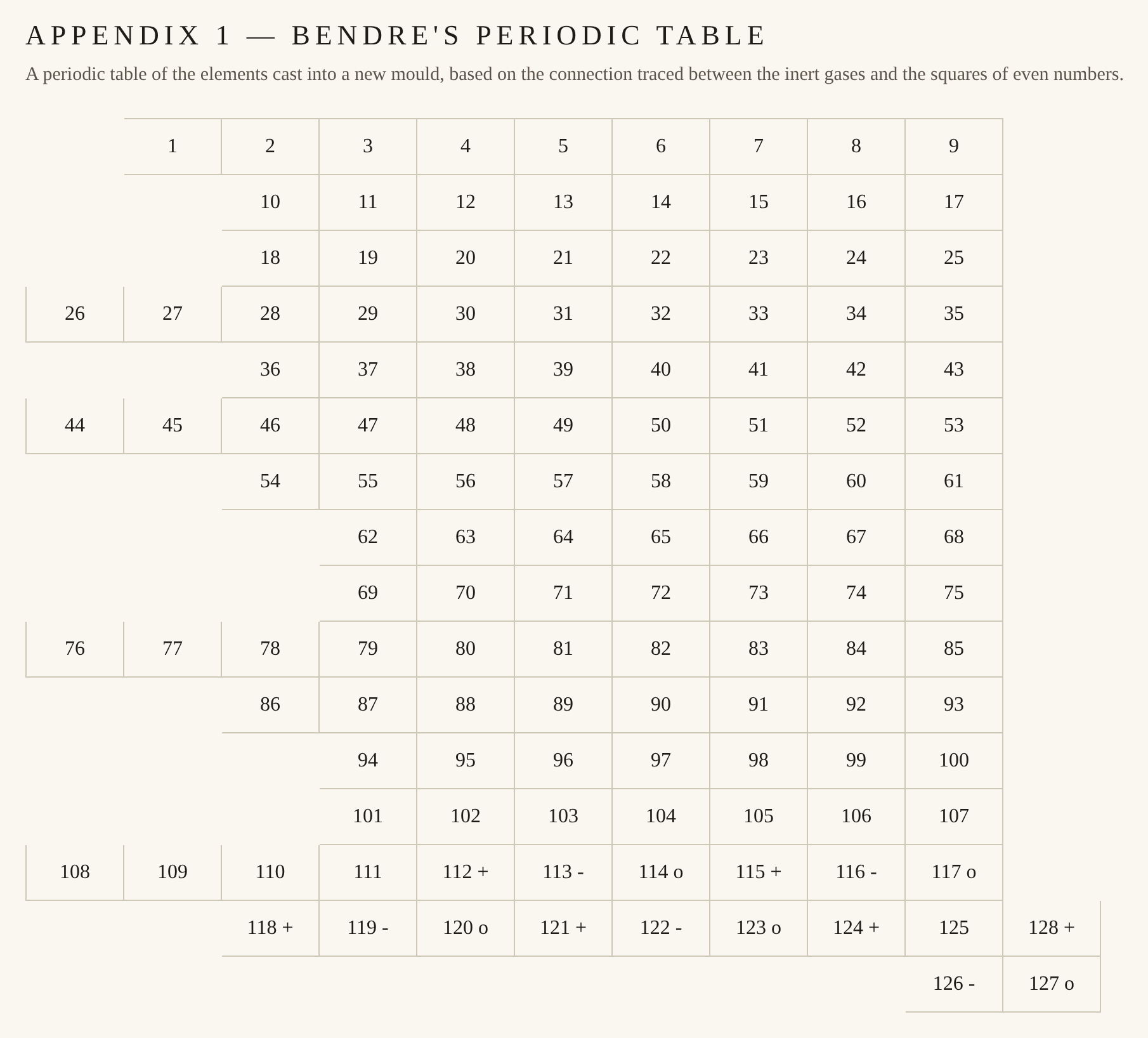
Based on Mendeleyev’s Periodic Table, Bendre conducted some significant research in this field. He developed a new Periodic Table based on this research. Among various features of Bendre’s Periodic Table, I will enumerate here only two important ones. Scientists have expanded Mendeleyev’s Periodic Table & have included in it elements upto Atomic Number 111. In recent times, they have extended it upto 118. Bendre, in his work “Theory of Immortality” has unveiled his Periodic Table (Appendix). In this, he has expanded the scope to include elements upto Atomic Number 127. Even before scientists around the world could discover & announce newer elements, Bendre did it in his Periodic Table. A critique of the same goes as below:
This is Dr D.R.Bendre’s Periodic Table. This is a Periodic Table cast into a new mould. In the typical Periodic Table, it stops at 118. In his Periodic Table, Bendre stops at 128, because there is a gap of freedom until a Prime & Perfect Number is reached. In the Periodic Table, five pairs of numbers are underlined. They are 18-19, 27-28, 52-53, 90-91 and 101-102. At these stages, there is a deviation of the principle laid down in the law of atomic weights. Dr. Bendre has traced two more such pairs which are unmanifest. The causation advanced by Dr. Bendre for the deviation is the radioactive decay that sets in at those stages.
This Periodic Table is seen in Bendre’s “Theory of Immortality - a probable problem and a possible cause” published on November 1, 1977. It is shown here in as Appendix 1.
Regarding this Periodic Table, I would like to draw your attention to two important topics.
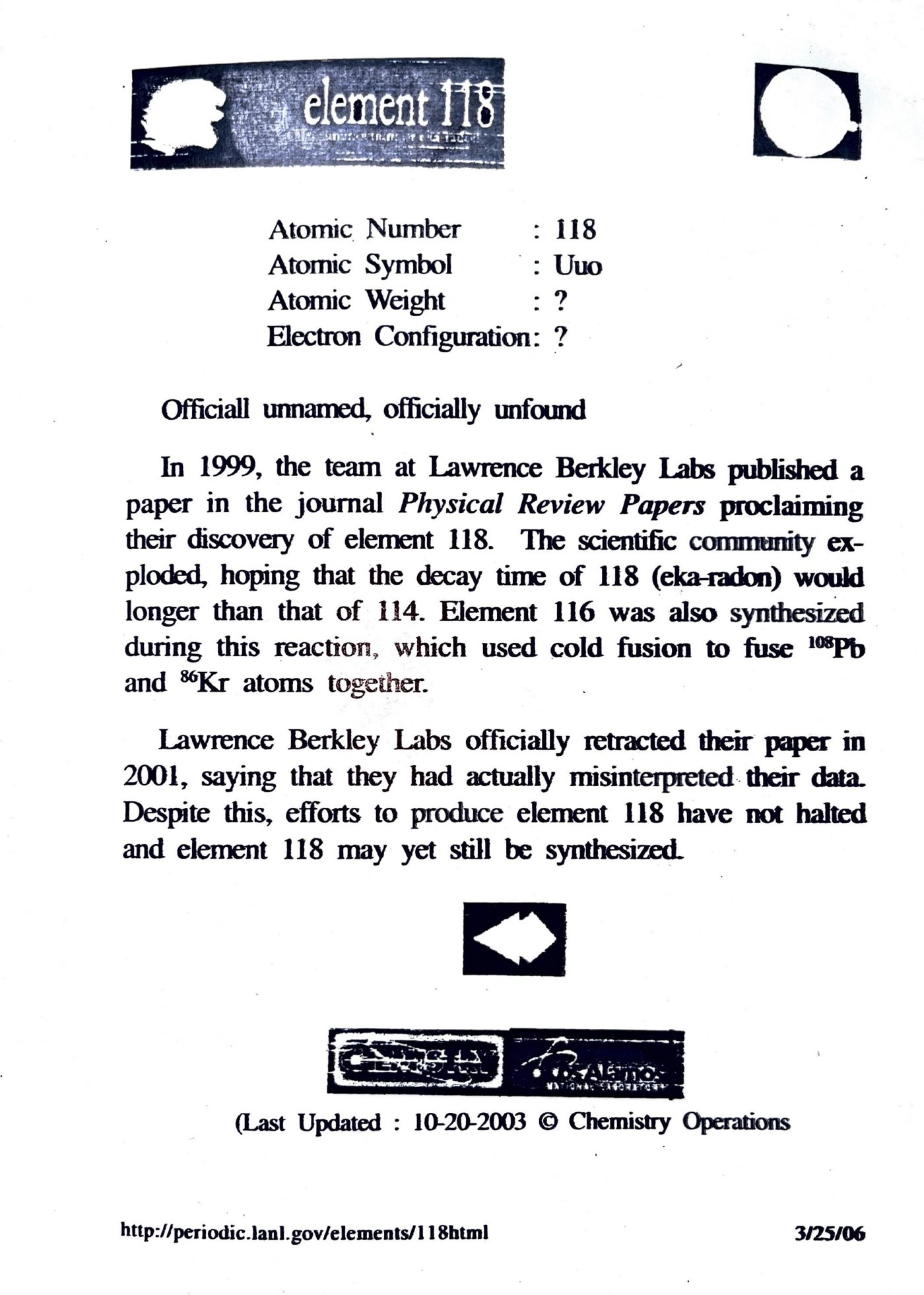
In Annexure 2, the details of element 118 have been shown as seen in the computer database today (26.03.2006). In Annexure 3, a recent news published by Lawrence Berkeley Lab related to element 118 is shown. This Lab has retracted the element 118 saying that more research needs to be done to prove its existence. This is something to take note of - since Bendre, in his Periodic Table published in 1977, had already shown existence of elements upto 128 - while scientists today, have not even reached 118! This is a testament to Bendre’s scientific research capabilities.
There is another related topic which I would like to elaborate now. On 27.12.1979, Bendre had an intense discussion with the world renowned physicist E.C.G.Sudarshan in a hospital in Dharwad, where he was getting treated after being very sick. In this discussion, the topic of Periodic Table also came up. Bendre asked the scientist Sudarshan “In the Periodic Table, at 5 places, as the Atomic Number increases, the Atomic Weight, instead of increasing, actually decreases. This goes against the Law governing the Periodic Table. How do you account for this deviation?” Sudarshan replied “There is no explanation for this in Science. We call them as Mystic Elements.” Bendre responded that he has discovered an explanation for this phenomenon using the principles of Astronomical Sciences. Sudarshan was stunned. This is another example illustrating Bendre’s exploits in scientific field.
Now, we will look at the third aspect of Bendre’s study into Scientific Philosophies - Cosmology.
Bendre’s “Theory of Immortality - a probable problem and a possible solution” has been included in a publishing “Bendre Cosmology Series - I” which came out on 01.11.1977 from the offices of Karnataka Rajyotsava Committee. This is the first publication on Bendre’s Cosmology studies. In this, we see six concepts put forth by Bendre. He has challenged the intellectuals of the world as follows - “Western dogmatism called Christian morality talks of a humanity of their own conception while their brothers, the rational scientists dare speak that they are not concerned with good and evil. This is a crisis. This is also a challenge. Dr. Bendre responds to this crisis and answers this kicking challenge of the Western arrogance and ignorance with his Theory of Immortality in contrast with mortality. He gives a call to those intelligent human beings who care to understand and are aware of this crisis in human affairs on a global scale, to come forth to take up the challenge. Dr. Bendre’s Theory of Immortality - a probable problem and a possible solution is also a challenge to a challenge and through the riddles he has posed in this paper, he seeks to solve them.” Bendre, through his “Cosmology” publication, has challenged the intelligentsia in order to resolve humanity’s confusions. He has expressed confidence that the findings of his studies straddling the realms of Science & Philosophy would help resolve some of the critical challenges being faced by humanity today. This shows the farsightedness of the philosopher sage, Bendre.
Since the Mahavijnani-Mahatatvajnani Bendre was also a Mahakavi, we find his elements of his scientific studies in several of his poems. I would like to elucidate some below:
“Hakki Harutide Nodidira - Bird is flying, have you noticed” - is one of Bendre’s most popular poems. Let us look at these lines from the poem
“Belliya halliya mereya Miri; Tingalurina niranu hiri; Aadalu haadalu ta haaraadalu; Mangala lokada angalakeri; Hakki harutide nodidira”
Much before man reached the moon, let alone Mars, Bendre’s flying bird had already taken flight & reached Mars way back in 1978.
“Ananta Pranaya” is another popular poem composed by Bendre
“Uttara dhruvadim dakshina dhruvaku; Chumbaka gaaliyu biisutide; suuryana bimbake chandrana bimbavu; Rambisi nageyali biisutide”
It is an established fact that there exists a Magnetic Pull & Magnetic Field between the North & South Poles. Bendre talked about this in 1977.
He composed the poem ‘’Suryapaana” in 1956. Here he has very poignantly articulated how the heart pines for seeking the light of scientific knowledge
“Suryapaanava noodu heege nintihudu; Enuvante - divyateya diikshe intihudu; Meru dandavu chigitu huuta haage; Hrudayadakootide kannu meege”
Thus has Bendre elucidated his findings on Science in his inimitable style - in prose & poetry.
“Hosa srushtiye barabahudu - A new universe will emerge” - let us all labour to create that new universe. This would be the most apt homage that we would pay to the Mahakavi - Mahavijnani - Mahatattvajnani
Appendices